
You got a number.
Maybe a doctor read it out to you at the end of a ten-minute appointment and moved swiftly on. Maybe you ordered a home test, opened an app, and found yourself staring at a figure you didn’t know how to hold. Maybe you’ve known your result for months and have spent a significant portion of that time either catastrophising or quietly hoping the internet was wrong.
I’ve been there. That number – your AMH – has a way of arriving with enormous emotional weight attached to it, usually without nearly enough context to make sense of it.
So let’s fix that.
This article is going to tell you what AMH actually measures, what the science says it can and cannot predict, how it behaves differently when you’re trying to conceive naturally versus going through IVF, and – most importantly – how to use it to make a better decision about what you do next. I am going to be honest with you about where the evidence is clear, and equally honest about where it is not. Because on this particular topic, a lot of people – including some clinicians – are working from an outdated script.
What AMH is actually measuring
AMH stands for Anti-Mullerian Hormone. It is produced by the granulosa cells that surround your developing follicles – specifically the small pre-antral and early antral follicles that sit in a kind of waiting pool in your ovaries.
Here is the key thing to understand: AMH is a proxy for how many of those small follicles are present. That is it. It is, essentially a headcount of the waiting room – not an assessment of who is in the room, not a measure of what those follicles will do, and not a verdict on your reproductive future.
The more small follicles you have in reserve, the more granulosa cells there are to produce AMH, and the higher your circulating AMH level. As your follicular pool diminishes with age – which is a normal and universal process – AMH falls with it. By the time menopause arrives, AMH is effectively undetectable.
This is why AMH has become such a popular clinical tool. Unlike FSH (follicle-stimulating hormone), which fluctuates across your cycle and tends to rise only once ovarian reserve is already substantially diminished, AMH can be measured on any day of the cycle and gives an earlier signal of declining reserve. It also correlates well with antral follicle count (AFC) – the number of visible follicles seen on transvaginal ultrasound – making it a useful, accessible, and relatively stable marker.
What it is not – and this distinction matters – is a measure of egg quality. Quantity and quality are separate biological variables. A woman with low AMH can have excellent egg quality. A woman with high AMH can have poor egg quality. The two are not the same thing, and the conflation of them is responsible for enormous and often unnecessary distress.
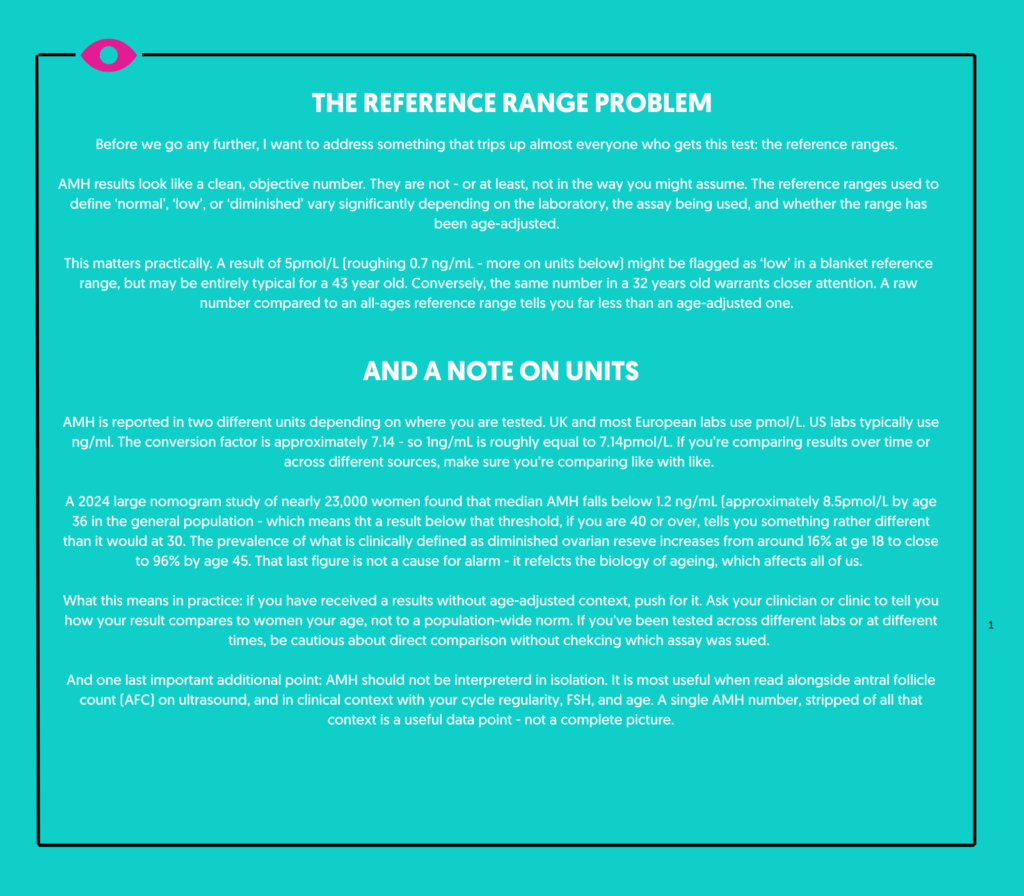
Does low AMH affect natural conception? The honest evidence
This is the question most women with a low result are actually asking. And it is where I want to be most careful with you, because the clinical conversation on this has genuinely evolved – and the answer is more nuanced than either of the two versions you typically hear.
Version 1 (the old consensus): AMH has nothing to do with natural conception in women who are ovulating regularly. Don’t worry about your number.
Version 2 (the fear based version): Your AMH is low. Time is running out. You need to act now.
Neither is accurate. Here is what the evidence actually shows.
The older consensus – and why it still matters
The foundational study on this question is Steiner et al. (2017), published in JAMA – one of the most cited papers in this space. It followed 750 women aged 30-44 trying to conceive. After adjusting for age and other confounders, women with low AMH (below 0.7ng/mL) did not have significantly different conception rates compared to women with normal AMH. The conclusion was reassuring: AMH did not appear to predict natural conception.
A subsequent follow-up analysis from the same research group, published in 2023 and examining outcomes up to 12 years later in the same cohort, found no association between diminished ovarian reserve and reduced probability of future live birth, future infertility diagnosis, or future time to pregnancy.
This is genuinely important data. It informed clinical guidelines – including ACOG (the American College of Obstetricians and Gynaecologists), which has stated that AMH should not be used to counsel patients in the general population about time to pregnancy.
Where the evidence gets more interesting
In 2024, the largest prospective cohort study to date on this question was published in Fertility and Sterility – authored by Anne Steiner herself, the same researcher behind the 2017 paper. This study followed 3150 US women who had purchased a home hormone test and were actively trying to conceive. After adjusting for age, BMI, parity, smoking and PCOS, women with low AMH had a statistically significant association with longer time to pregnancy – and this held even in the subgroup of women with regular menstrual cycles.
The finding is important. But so are its limitations. The study population was self-selected – women who buy home hormone tests are not a random sample. They tend to be more health aware, more anxious about fertility and are more likely to be actively monitoring their cycles. That does not invalidate the findings, but it is worth naming when you interpret them.
An earlier Danish cohort study (Birch Petersen et al., 2015, n=260) also found a stepwise relationship between AMH and pregnancy rate over two years: 60% in the low-AMH group versus 78% in the high-AMH group. Importantly, natural conception occurred even in women with AMH as low as 1.2pmol/L – a very low level.
My Take on this evidence
The old ‘AMH is irrelevant to natural conception’ line is no longer the complete story. The 2024 data – the largest dataset we have – suggests a real, modest association. But modest is the operative word. A longer time to pregnancy is meaningfully different from inability to conceive. In every study, natural conceptions have occurred even at very low AMH levels. Age remains a stronger predictor of natural conception than AMH in all of the data.
Does low AMH mean you ovulate less often?
No – not in any clinically meaningful way. What the evidence suggests is that declining ovarian reserve may be associated with slightly shorter menstrual cycles, reflecting earlier ovulation. But regularly cycling women with low AMH are, in general, still ovulating regularly. The number of eggs released per cycle doesn’t change – it remains one. What changes is the pool those eggs are drawn from, and how long that pool will sustain regular ovulation.
AMH and IVF: where the number actually matters
This is where AMH earns its clinical weight.
In IVF, AMH is a genuinely powerful predictor – not of whether you will have a baby, but of how your ovaries are likely to respond to stimulation. Specifically, how many eggs the clinic can expect to retrieve per cycle.
This matters for several reasons. More eggs retrieved means more potential embryos to assess. More embryos means more chances to identify viable ones, particularly if chromosomal testing (PGT-A) is being used. Fewer eggs retrieved – what’s called a poor ovarian response – means fewer opportunities per cycle, and often means more cycles are needed to reach the same endpoint.
A useful framework: think of AMH as predicting the size of your IVF egg harvest. A women with a high AMH might expect 12-15 eggs retrieved per cycle. A women with low AMH might expect 3-5. Both of these women can have a successful transfer – but their journeys to get there may look very different in terms of number of cycles and the emotional and financial cost of each.
The critical distinction that often gets lost
Poor ovarian response is not the same as poor prognosis.
A woman who retrieves 3 eggs, gets 2 fertilised embryos, sends them for chromosomal testing, and gets one euploid (chromosomally normal) embryo back, has the same chance of successful transfer as a woman who retrieved 15 eggs and went through the same process. The euploid rate – the proportion of embryos that are chromosomally abnormal – is driven primarily by age, not by AMH or egg number. At 40, roughly 50-60% of embryos will be aneuploid (chromosomally abnormal) regardless of how many eggs are retrieved. At 43, that figure rises to 70-80%.
What this means is that AMH informs how many cycles you might need – it doesn’t determine the outcome of each cycle.
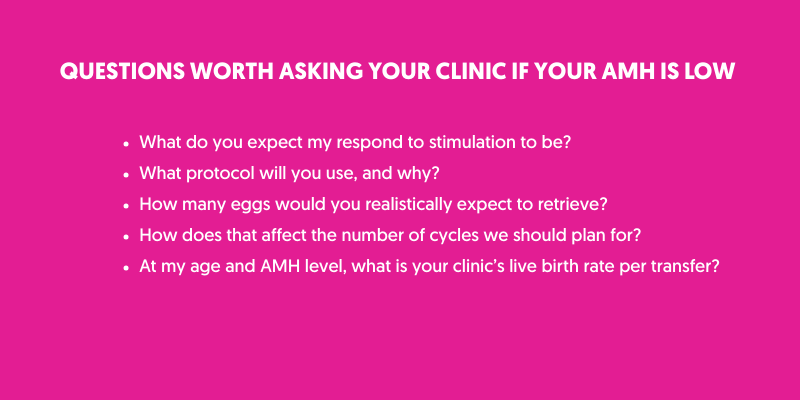
A good clinic will answer these directly and without evasion. A less good clinic will lead with AMH as a measure of how ‘good’ your eggs are – which, as I have established, is not what it measures.
What AMH cannot tell you.
This is worth stating plainly, because the gap between what AMH measures and what people assume it measures is where most of the unnecessary anguish lives.
AMH cannot tell you:
- The quality of your eggs. Egg quality – specifically chromosomal integrity – is driven primarily by age and is not reflected in AMH
- Whether a given egg will fertilise. Fertilisation depends on egg and sperm quality, and the conditions of the laboratory if you’re doing IVF.
- Whether an embryo will be chromosomally normal. This is an age-driven variable, not an AMH one.
- Whether an embryo will implant. Implantation is influenced by embryo quality, endometrial receptivity, and other factors AMH does not capture.
- Whether you will micarry. Miscarriage risk at 40+ is primarily driven by aneuploidy – chromosomal abnormality in the embryo – which is an age effect, not a an AMH effect.
- Whether you can conceive. Even with a very low AMH, natural conception and IVF success are possible. AMH modifies probability; it doesn’t determine outcomes.
How to use your result: a framework for next steps
Here is how I would think about this, depending on where you are.
If your AMH is low and you are trying to conceive naturally
The most important question is whether you are ovulating regularly. If you have a regular cycles, your AMH result doesn’t change the mechanics of trying – one egg per cycle, same as always. What it may mean is that the window of regular ovulation is shorter than it would be with a higher reserve. This is a reason to take timing seriously and to not delay investigation if things are not working – but it is not a reason to panic.
I would suggest not trying entirely unassisted for more than six months at 40+ regardless of your AMH level. The NICE guideline threshold for investigation infertility drops to six months for women over 35 in the UK. ASRM guidance in the US is similar. Your AMH result is one additional piece of information in that picture – it may inform how urgently you pursue investigation, but the age threshold for seeking help is the more important driver.
If your AMH is low and you are considering or already in IVF
Your result is most clinically meaningful here. Use it to have an explicity conversation with your clinic about expected response, realistic egg numbers per cycle, and what that means for your overall plan. Ask how many cycles you should budget for – financially and emotionally. Ask what protocol they intend to use and whether there is evidence for it in poor responders specifically. And make sure you are being counselled on cumulative success rates across multiple cycles, not just per-cycle figures, which can feel discouragingly small in isolation.
If your AMH is very low – below approximately 0.4ng/mL (2.8pmol/L) – or undetectable
This changes the conversation, and I think it deserves honesty. At this level, the pool is genuinely small. Natural conception remains possible but becomes less likely as the reserve approaches exhaustion. In IVF, the clinic may retrieve only one or two egs per cycle, or sometimes none. This is also where egg donation becomes a realistic option to discuss rather than a devastating last resort. I will cover that conversation in more detail in a separate article but I want to name it here: egg donation is not giving up. For some women it is the clearest path to parenthood, and deserves to be on the table early enough to consider properly.
The number is data, not a verdict
I want to come back to where we started.
You have a number. It is real data. It tells you something genuine about your ovarian reserve – about the size of the pool your eggs are being drawn from. That is worth knowing. It is worth factoring into your decisions.
But it does not tell you whether you will conceive. It does not tell you what your eggs are like. It does not set a deadline. And it does not define what is possible.
The evidence of AMH and natural conception is more nuanced than either the fatalistic or the falsely reassuring version you may have been offered. The evidence on AMH and IVF is clearer – it predicts response, not outcome. In both contexts, age remains the most powerful variable in the room.
Use this number as one lens, alongside your AFC, your age, your cycle regularity, and your own circumstances. And use it to ask better questions – of your clinician, your clinic, and yourself about what you actually want and what timeline makes sense for you.
That is what the data is for.
References and Evidence notes
1. Steiner AZ et al. Association Between Biomarkers of Ovarian Reserve and Infertility Among Older Women of Reproductive Age. JAMA. 2017;318(14):1367–1376.
👉 https://pubmed.ncbi.nlm.nih.gov/29049585/
2. Harris BS, Steiner AZ et al. Markers of Ovarian Reserve as Predictors of Future Fertility. 2022.
👉 https://pubmed.ncbi.nlm.nih.gov/36460524/
3. Steiner AZ et al. Antimüllerian Hormone Levels Are Associated with Time to Pregnancy in a Cohort of 3,150 Women. Fertility and Sterility. 2024.
👉 https://pubmed.ncbi.nlm.nih.gov/38964587/
Full text: https://www.fertstert.org/article/S0015-0282(24)00592-2/fulltext
4. Korsholm AS, Birch Petersen K et al. Investigation of Anti-Müllerian Hormone Concentrations in Relation to Natural Conception Rate
Leave a Reply

READ >
If you have read the AMH article in this series, you already know that AMH measures quantity – the number of eggs left in your reserve – not quality. Quality is however what most people are actually worried about. And yet it is the less well understood of the two. Egg quality, in the way […]
READ >
You got a number. Maybe a doctor read it out to you at the end of a ten-minute appointment and moved swiftly on. Maybe you ordered a home test, opened an app, and found yourself staring at a figure you didn’t know how to hold. Maybe you’ve known your result for months and have spent […]

READ >
Dr Deepak Ravindran is one of the UK’s leading pain specialists. He is one of the few medical consultants who possesses triple certification in lifestyle medicine, musculoskeletal medicine and pain medicine using all of this knowledge to give his patients a truly integrative and holistic approach. He is author of the book The Pain-Free Mindset […]

READ >
Ellie Grace is a trauma informed yoga educator with an MA in Yoga Studies – who lectures medical undergraduates in the neurophysiology of yoga to nurture their personal development and prevent burnout – which has never been more important. Doctors are experiencing workplace burnout at the highest ever levels recorded, with findings from the regulator’s […]

READ >
Lisa Ryan is a physiotherapist turned trauma informed somatic practitioner who helps people find freedom from their persistent pain. And this is just so important to her – because she was once a patient herself who was told she was not expected to recover – and the best she could hope for was to manage […]

READ >
Tanya Cole-Lesnick is a psychotherapist, licensed clinical social worker, and personal development coach who is focused on helping people clear their energetic clutter to pursue a life that honors their truest selves. Tanya really believes in the power of the group in the work she does – which is what I want to talk to […]
Follow the journey
@DR.BODYMINDSOUL